


A Term That Gets Misused
“High clearance” is one of the most commonly used terms in off-road builds, especially when it comes to front bumpers. But on the GX 550, the term is often misunderstood.
Many assume it simply means cutting the bumper higher or removing material. In reality, true clearance is more complex—it’s about how the bumper interacts with the vehicle under real conditions, not just how it looks when parked.
Understanding what high clearance actually means can make a significant difference in how the vehicle performs on the trail.

Static vs Functional Clearance
The biggest misconception is focusing only on static clearance—the space visible when the vehicle is sitting still.
Functional clearance considers what happens when the vehicle is:
-
Climbing obstacles
-
Descending steep terrain
-
Articulating over uneven surfaces
A bumper that looks high-clearance at rest may still make contact under compression or forward pitch.
What is functional clearance?
It’s the usable space a vehicle maintains when moving through terrain, not just when sitting still.
Approach Angle Is Only Part of the Equation
Approach angle is often used as the main measure of clearance, but it doesn’t tell the full story.
While improving approach angle helps, real-world performance also depends on:
-
Bumper shape and profile
-
How edges interact with obstacles
-
Clearance around tires and suspension movement
A design that looks aggressive may still create contact points if these factors aren’t considered.
The Role of Bumper Geometry
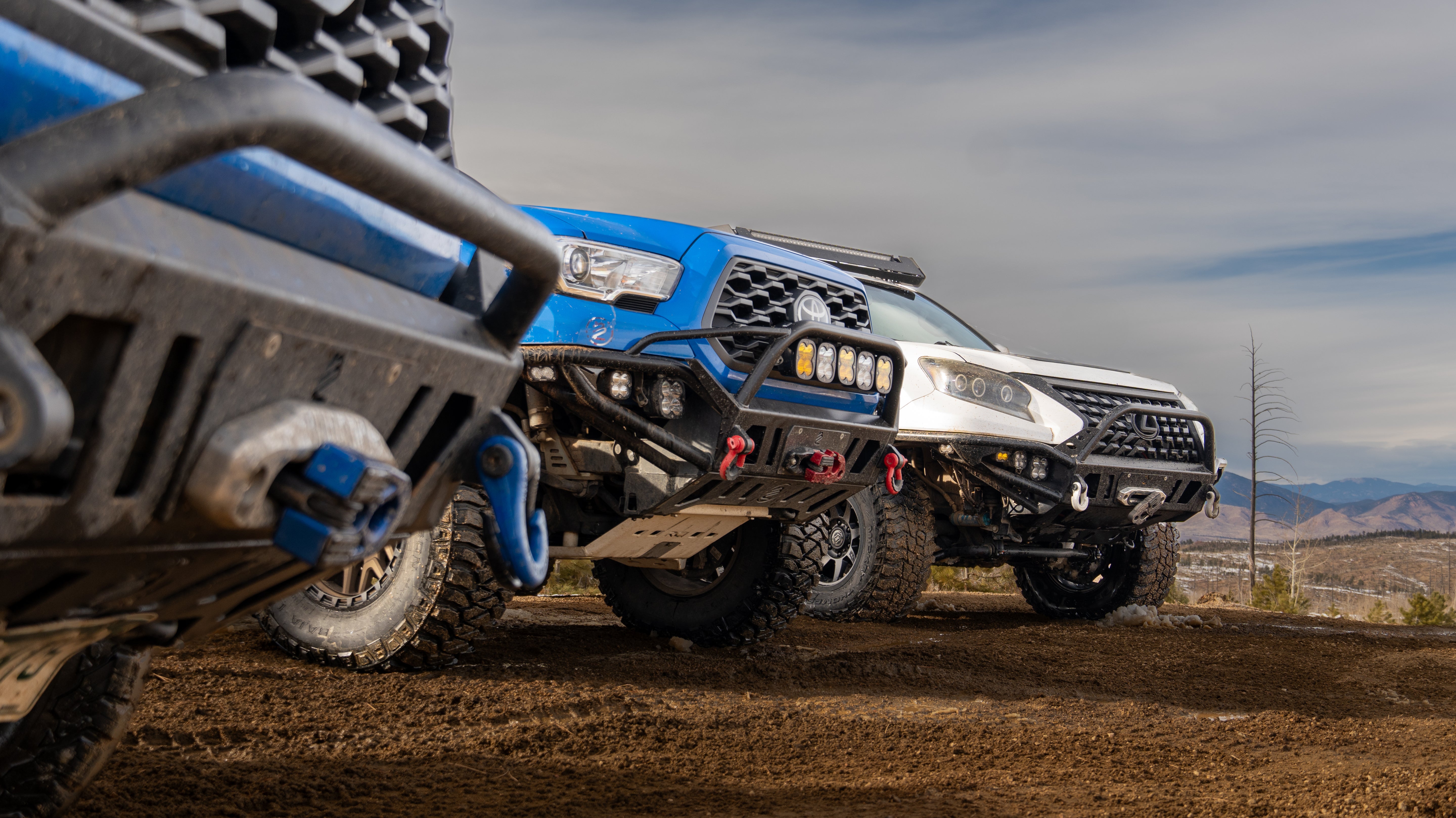
Geometry plays a critical role in how a bumper performs. Smooth transitions, angled surfaces, and strategic shaping help guide the vehicle over obstacles instead of catching on them.
Effective high-clearance design often includes:
-
Angled lower edges to reduce impact points
-
Tapered sides for better tire clearance
-
Compact profiles that stay close to the body
These elements work together to improve how the vehicle moves through terrain.
Does shape matter more than height?
In many cases, yes—geometry determines how the bumper interacts with obstacles.
Balancing Clearance With Protection
Increasing clearance often involves removing material, but too much removal can expose critical components.
A well-designed bumper balances:
-
Clearance for obstacle navigation
-
Protection for key systems like the radiator and lights
-
Structural strength for recovery and impact
On the GX 550, this balance is especially important due to the vehicle’s integrated systems and refined design.
Real-World Scenarios Where Clearance Matters
Clearance becomes most noticeable in situations like:
-
Climbing rock ledges
-
Navigating deep ruts
-
Approaching steep inclines
In these scenarios, even small differences in bumper design can determine whether the vehicle clears an obstacle or makes contact.
Will high-clearance bumpers make a big difference?
Yes—especially in technical terrain where approach angle and geometry are critical.
Conclusion: Clearance Is About Performance, Not Looks
On the GX 550, high clearance isn’t just a visual feature—it’s a functional characteristic that directly affects performance.
Understanding the difference between static and functional clearance, and how geometry plays a role, helps ensure that a front bumper actually improves capability rather than just appearance.
Because in real off-road conditions, what matters isn’t how high a bumper looks—it’s how well it works.























Share:
Why Most Front Bumper Failures Start at the Mounting Points
Best GX 550 Front Bumper Setup by Use Case